In diesem Artikel
- TL;DR
- 1. The Old Story Was Wrong: Bitcoin Miners Are 100% Heaters
- 2. The Industrial Ceiling — Why Mega Miners Are Cornered
- 3. The Heat Reuse Stack: Where Mining Goes Next
- 3a. Space heaters — the gateway drug
- 3b. Water heaters — the sleeper hit
- 3c. District heating — the EU advantage
- 3d. Industrial low-grade heat (≤180°F)
- 4. The Money: When Does a Bitcoin Heater Pay Off?
- Three business models for getting Bitcoin heaters into homes
- 5. The Bottleneck: Open-Source Hardware
- 6. Should You Mine at Home in 2026? A Decision Framework
- Three tiers, three real builds
- What NOT to do
- 7. The Long View — 30 Years Out
- 8. Frequently Asked Questions
The US grid took a cold front a few weeks ago. Hash rate dipped. Not because miners failed — because they were meant to dip when the homes plugged into them needed every available watt for warmth. That detail is small, and it's the entire future of Bitcoin mining in one sentence.
This piece builds on Tyler Stevens' interview on the Bitcoin Rails podcast. Tyler is the author of Bitcoin Mining Heat Reuse and serves on the board of the 256 Foundation, the open-source mining nonprofit. If you want the long version in his own voice, watch below — then come back for the 2026 reader's guide.
TL;DR
- A Bitcoin miner is a 100%-efficient electric heater that happens to pay you in sats.
- Industrial mining hit a ceiling: closed firmware, three-phase power, no heat offtaker.
- The next wave runs in homes, water heaters, and small commercial buildings.
- The math works best for cold-climate, rural homes burning propane or heating oil — not natural gas.
- The bottleneck isn't physics. It's open-source hardware (Bitmain controls ~80% of the market).
- The 256 Foundation is shipping an open stack: Ember 1 hashboard, Mujina firmware, Libra control board, Hydropool mining pool.
- In 30 years, most of Bitcoin's hash rate may not run on Bitcoin mines at all — it'll run on appliances.
1. The Old Story Was Wrong: Bitcoin Miners Are 100% Heaters
Drop a Bitcoin miner into a closed room and measure the temperature. It rises. Not because mining is "wasteful" — because there is no other place for the energy to go.
Every Bitcoin miner is, electrically speaking, an electric resistive heater. Power flows through silicon. The silicon resists. That resistance produces heat. The same physics behind your toaster, your kettle, and the baseboard heater in your guest bedroom. The only difference: along the way, the silicon also tries to guess a number that, if correct, mints a block reward.
The "wasteful mining" narrative assumed the heat had nowhere to go. That assumption broke quietly somewhere between 2020 and now.
I came in seeing these things as useful electric heaters that happen to pay you in sats.
That single reframe — heater that pays you in sats, not miner that emits waste heat — is the entire pitch of the home mining movement. Once you see it, the rest of this article is just engineering and money.
2. The Industrial Ceiling — Why Mega Miners Are Cornered
Walk into a Texas mining warehouse. Twenty thousand machines, 480-volt three-phase service, fans the size of small cars, ambient temperature in the equipment hall around 95°F. The heat is enormous. And it goes nowhere — vented to the desert sky.
That's the mega-miner business model: get the cheapest electricity, use the latest ASIC, treat heat as a problem to engineer around. It worked while Bitcoin was small and electricity was cheap. It is now hitting three structural limits.
Three-phase power locks them out of the home. MicroBT's new 70-series miners — 10 of the 14 models — require 480V three-phase service. That isn't a household outlet. It isn't even a dryer outlet. It's a dedicated industrial service. Mega-miners are sprinting away from the residential market faster than the residential market can sprint toward them.
Closed firmware is a single point of failure. Bitmain controls roughly 80% of the ASIC market. Their firmware is closed-source. The industry has caught them red-handed before — Antbleed, the remote kill-switch baked into older firmware, was a real bug discovered in 2017. ASIC Boost, a chip-level optimization, was reportedly sold inside the factory before being publicly disclosed. Every mega-miner is, in effect, trusting a single Chinese company not to skim from the top, brick the fleet, or sell out their hash rate to a state actor.
Hash price keeps grinding toward zero. As more efficient machines flood the network, the dollar value of one terahash falls. Mega-miners survive by being the lowest-cost producer — which means the entire industry is running a treadmill toward zero margin. The bottom of that hill is hash price = 0. At that point, the only mining that survives is mining where the heat is the product.
That is the moment the industry pivots. Not because the megas chose to — because the megas got cornered.
3. The Heat Reuse Stack: Where Mining Goes Next
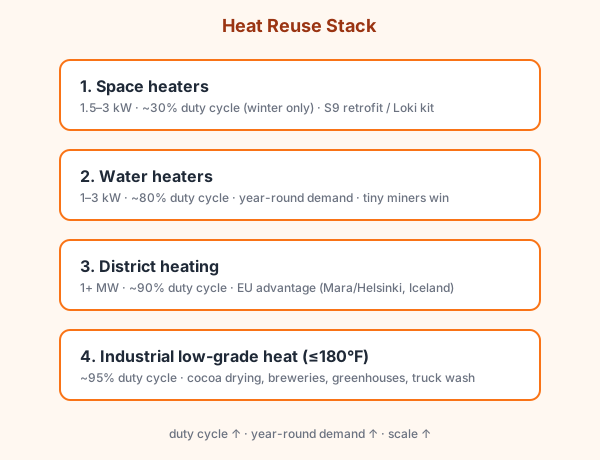
There isn't one home-mining product. There's a stack of four — each with different physics, different economics, and different customers.
3a. Space heaters — the gateway drug
This is where the movement started. Hobbyists at meetups, an old Antminer S9, a Loki kit to convert the power supply to standard 110V household current, larger Noctua fans replacing the screaming stock fans, a 3D-printed shroud, and you have a 1.5 kW Bitcoin space heater that runs in a corner of your living room.
Pros: cheapest entry point, fully reversible, you tinker with it yourself. Cons: low duty cycle (you only use space heaters when it's cold), still loud unless you put real money into the retrofit.
3b. Water heaters — the sleeper hit
Almost no one talks about water heaters. They should. Hot-water tanks are a closed loop: you heat 50 gallons once and the heat just sits there until someone takes a shower. The result is a very low duty cycle for the heating element — but the heat demand is constant across the year, summer included.
A Bitcoin water heater wants the opposite of a Bitcoin space heater: a tiny miner running long hours, not a big miner running occasionally. That changes the product design completely. The recovery time stinks (it'll take a tiny miner forever to reheat a drained tank), so the engineering challenge is real. But the addressable market is every house in the country, every season.
3c. District heating — the EU advantage
In Helsinki, Marathon Digital is feeding mining heat into a district heating network — pumping warmed water under city blocks to heat thousands of homes. In the US, district heating is rare; in Northern Europe and Iceland, it's standard infrastructure. That asymmetry alone could put EU heat-reuse mining years ahead.
3d. Industrial low-grade heat (≤180°F)
Bitcoin miners cap out at about 180°F before the silicon dies. That puts them in the "ultra-low-grade heat" bucket — useless for steel, glass, or chemicals, but perfect for:
- Cocoa drying in West Africa (the use case that first surfaced in Alex Gladstein's Hidden Costs of the Petrodollar talks)
- Brewery and distillery operations
- Greenhouses in northern climates
- Truck-wash bays in mountain states (a friend of Tyler's runs one in Idaho)
These are unsexy applications. They're also high duty cycle, weather-independent, and every business already pays for the heat. Replacing the propane bill with a Bitcoin heater is a straight P&L upgrade.
4. The Money: When Does a Bitcoin Heater Pay Off?
Here is the comparison nobody on Bitcoin Twitter wants to do honestly. Convert every heating fuel to a $/kWh-equivalent, then ask whether the Bitcoin subsidy on a heater (≈50% of electricity cost in early 2026) closes the gap.
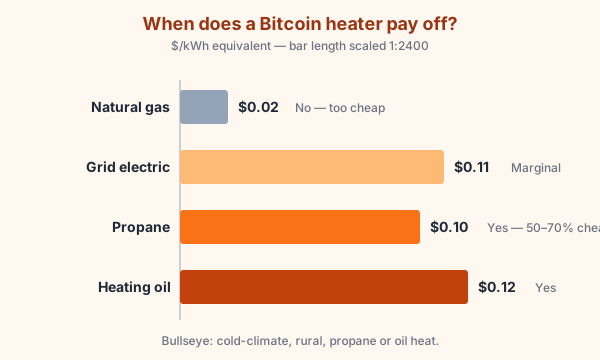
| Heat source | $/kWh equivalent | Bitcoin subsidy makes sense? |
|---|---|---|
| Natural gas (US, piped) | ~$0.02 | No. Five times cheaper than electric — the BTC subsidy can't bridge that. |
| Grid electric resistive | ~$0.11 | Marginal. Worth it if you'd be using electric anyway. |
| Propane (rural US) | ~$0.10 | Yes. Bitcoin heater lands 50–70% cheaper. |
| Heating oil (US Northeast, Alaska) | ~$0.12 | Yes. Same range as propane. |
Your bullseye customer is a cold-climate, long-heating-season, rural household burning propane or oil. Cities with natural-gas pipelines stay on natural gas — for now. Florida and Phoenix never enter the conversation.
Three business models for getting Bitcoin heaters into homes
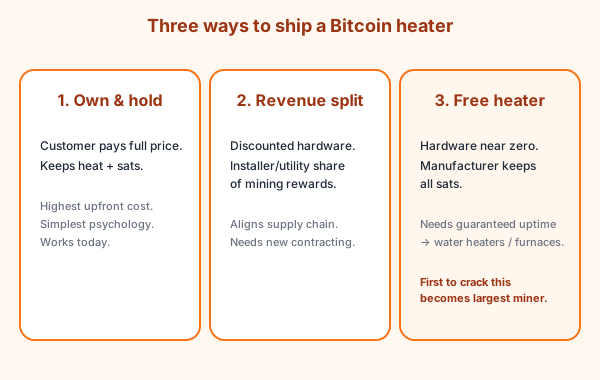
- Own and hold. Customer pays full price for the heater, keeps the heat, keeps the sats. Highest upfront cost, simplest psychology. Works today.
- Revenue split. Customer pays a discount, the installer/utility/HVAC company keeps a slice of the mining rewards. Aligns incentives across the supply chain. Needs new contracting infrastructure.
- Free heater, company keeps the sats. The radical model. The manufacturer subsidizes the hardware to zero or near-zero, betting on years of mining revenue from millions of installed units. Only works when you can guarantee uptime — so it works for water heaters and furnaces (no one unplugs those), not for portable space heaters.
We have not yet seen any of these models tested at scale. The first to crack the "free heater" model probably becomes the largest Bitcoin miner in the world by accident.
5. The Bottleneck: Open-Source Hardware
Everything above is real. None of it scales while Bitmain owns 80% of the market.
This isn't an ideological complaint. It's a straight engineering one. To build a Bitcoin water heater, you need ASIC chips. To buy ASIC chips at scale, you need a relationship with Bitmain or MicroBT. They sell to the highest bidder — currently CleanSpark, Marathon, and Riot — not to a startup hoping to pivot the heating industry. The few open-source efforts (Bitaxe and friends) are desoldering chips out of used Antminers they bought from China. That is not a manufacturing strategy.
The fix is the 256 Foundation — a 501(c)(3) nonprofit building a fully open-source mining stack across four projects:
- Ember 1 — open-source hashboard
- Mujina — open-source firmware (so you can verify what your machine is actually doing)
- Libra — open-source control board
- Hydropool — one-click open-source mining pool with multiple payout structures
In 2025 they ran a fundraiser livestream where pointed hash rate hit roughly 1 EH/s and the foundation hit a block. As of last month they have a fully open-source reference design — control board, hashboard, firmware, pool — mining live. The remaining gap is the chips themselves: Proto and a small number of newer entrants are pursuing access at TSMC, but it takes ~$100M to even get in line. An "open-source ASIC chip that's competitive" is probably a 5–10 year project, if it happens at all.
The pragmatic version of the goal isn't "open-source chips." It's "more than one chip vendor that will sell to you." That's enough to break the residential mining bottleneck.
6. Should You Mine at Home in 2026? A Decision Framework
Run these six questions before you spend a single dollar on hardware:
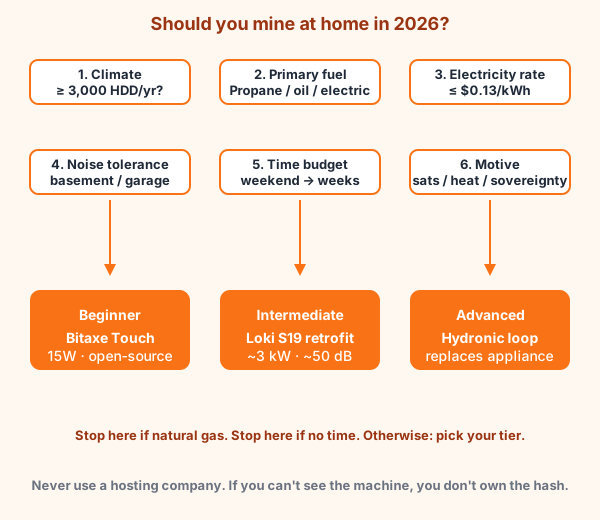
- Climate. How many heating-degree-days do you have per year? Below ~3,000, the duty cycle won't carry the math.
- Primary fuel today. Natural gas? Stop here — you won't beat $0.02/kWh. Propane, heating oil, or grid electric? Continue.
- Electricity rate. Below ~$0.13/kWh, the subsidy works. Above ~$0.20/kWh (parts of the EU and California), it gets harder.
- Noise tolerance. Do you have a basement, a utility closet, or a detached garage? If your only option is the living room, get a Bitaxe Touch and read the rest of this for context.
- Time budget. A retrofit takes a weekend. Hydronic integration takes weeks. Plug-and-play heatpunk products are still emerging.
- Motive. Sats? Bitaxe at home for the education + a stack of stats. Heating bill? Do the math against your fuel cost. Sovereignty? Build the open-source stack and run a Bitax + Hydropool combo.
Three tiers, three real builds
- Beginner — Bitaxe Touch. Around 15W (less than your phone charger), single open-source ASIC, pre-built and shippable. Mines as much heat as a hand-warmer. The point isn't the heat — it's that you personally run a node + miner without trusting Bitmain.
- Intermediate — retrofit Antminer S19 with a Loki kit. ~3 kW, real space heater, ~50 dB once you swap the fans. Practical heat output. Plan for a dedicated 30A circuit and acoustic isolation.
- Advanced — hydronic / hot-water integration. Hardware like Heatbit, or DIY immersion-cooled S19s tied into a hot-water loop. This is plumber-and-electrician territory. The reward is a "Bitcoin heater" that actually replaces an existing appliance line item.
What NOT to do
Don't sign up for a hosting company. The pitch is "Bitcoin mining is too hard, we'll run it for you and mail you the sats." It's the modern equivalent of leaving your coins on Mt. Gox. If you can't see the machine, you don't own the hash rate. The whole point of self-custody is the same point: hold the keys, hold the hash, hold the heat.
7. The Long View — 30 Years Out
Tyler's prediction: in 30 to 40 years, the vast majority of Bitcoin's hash rate isn't owned by Bitcoin mining companies. It's owned by appliances. Water heaters, furnaces, district-heating loops, server-room HVAC, brewery boilers — every gadget a normal person already pays to run, with hash rate baked in at the factory.
Mining stops being a separate business. It becomes a utility function — like the way a refrigerator's compressor isn't a "refrigeration startup," it's just a feature. At that scale, hash price can fall to zero and the network is still maximally secure, because the mining isn't financed by the block reward. It's financed by your hot water bill.
The thought experiment: General Electric or Bosch or Vaillant becomes the largest Bitcoin miner on the planet, by accident, because they shipped 50 million heaters with hash boards inside. The mining itself is irrelevant to GE's P&L — it's a free option on top of a heater they were already going to sell.
If that future arrives, the Bitcoin map of the world becomes a hash-rate heat map of the world: highest hash density in the coldest, longest winters. The next cold front in the US Midwest doesn't dip hash rate — it spikes it.
Whether that future arrives at all turns on the open-source hardware bottleneck above. The fundamentals are good.
About the author
Mohamed Habbat is a Product Owner at Bitcoin Suisse and the author of Bitcoin: Zero to Hero, a 19-chapter book that takes complete beginners to functioning Bitcoin self-sovereignty. He lives in Switzerland and has spent the last five years inside the Bitcoin industry.