Bitcoin Taxes in Switzerland: What Every Holder Needs to Know
Switzerland is one of the most tax-friendly jurisdictions in the world for Bitcoin holders. If you buy Bitcoin, hold it, and sell it at a profit, the Swiss federal tax system does not tax that gain. Zero capital gains tax. This single fact puts Switzerland in a different category from Germany, France, the United Kingdom, and the United States — all of which treat Bitcoin profits as taxable income in some form.
But bitcoin tax in Switzerland is not as simple as "it's free." The exemption comes with a test. Fail that test, and you are no longer a private investor in the eyes of the tax authorities. You are a professional trader. And professional traders pay income tax on every gain — at marginal rates that can reach 40 percent or higher depending on your canton. Most Swiss holders don't know this distinction exists until they find themselves on the wrong side of it.
This chapter explains the rules clearly: what is tax-free, what is not, what you must declare regardless, and what grey areas exist in the Swiss system today.
Capital Gains Are Tax-Free — For Private Investors
The starting point is clear. Switzerland does not levy a federal capital gains tax on movable private assets. Bitcoin is classified as movable private property. When a private investor sells Bitcoin at a profit, that gain is not taxable. The same applies to crypto-to-crypto activity — covered below.
This has been Switzerland's position since Bitcoin became relevant to Swiss taxpayers. The ESTV — the Eidgenössische Steuerverwaltung, Switzerland's federal tax authority — applies the same private investor framework to Bitcoin that Swiss tax law has long applied to stocks and securities. Buy low, sell high, keep the difference: the taxman does not follow you there.
To put this in concrete terms: if you bought 1 BTC at CHF 20,000 in 2020 and sold it at CHF 90,000 in 2025, your gain of CHF 70,000 is not taxable as a private investor. In Germany, that gain would be subject to income tax at your marginal rate. In the US, it would be subject to capital gains tax, either short-term (ordinary income rates) or long-term (up to 20 percent) depending on the holding period. In Switzerland, as a private investor, you owe nothing on the appreciation.
This advantage is real. It is one of the legitimate structural reasons why Switzerland has attracted Bitcoin holders and crypto companies alike. But the critical word in every sentence above is "private investor."
The Private Investor Test: Where Most Holders Go Wrong
The ESTV uses a five-criteria framework to assess whether someone is acting as a private investor or a professional trader. This framework is based on established Swiss tax doctrine, originally developed for securities trading and applied to cryptocurrency by analogy. Meeting two or more of these criteria can trigger reclassification as a professional trader — which removes the capital gains exemption entirely.
The five criteria are:
Holding period under six months. Assets sold within six months of purchase suggest trading activity rather than investment. A single short-term sale does not automatically trigger reclassification, but a pattern of it does.
High trading frequency. Frequent buying and selling, particularly if spread across many transactions per year, signals professional activity.
Use of leverage or borrowed capital. If you are trading with borrowed money — margin accounts, crypto loans, leveraged products — this is a strong indicator of professional trading. Private investors, by definition, trade with their own capital.
More than 50 percent of income derived from trading. If your gains from crypto trading exceed your income from employment or other sources in a given year, this criterion applies. This one catches some holders off guard during strong bull markets.
Systematic profit orientation. This is the broader catch-all: using professional-grade tools, systematic strategies, automated bots, or structured methods to generate profit from price movements.
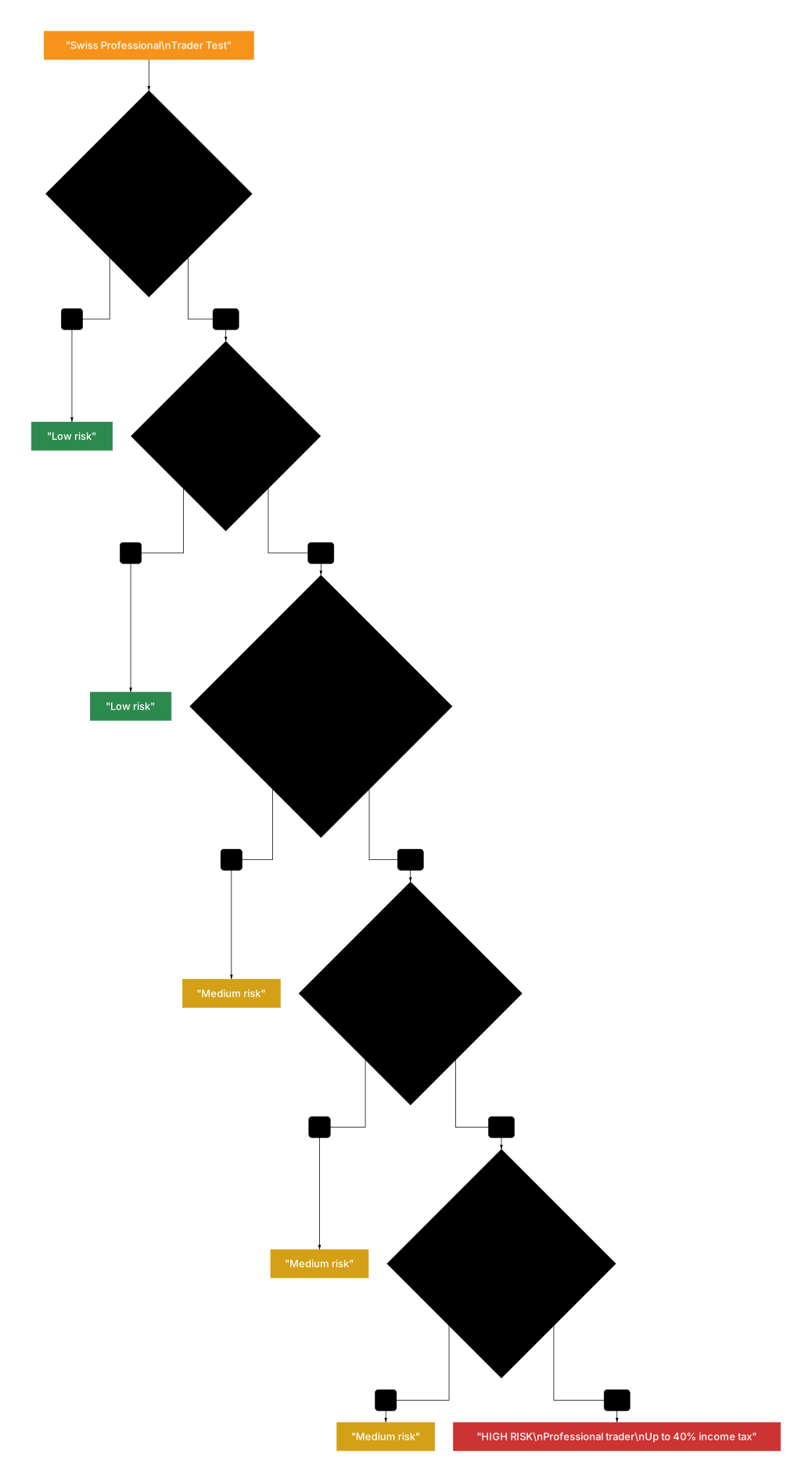
Meeting any two of these in a given tax year creates a risk of reclassification. The assessment is made by cantonal tax authorities, and different cantons apply these criteria with varying degrees of strictness. Zurich is generally reported to apply them more rigorously than Zug or Schwyz — though this is practitioner experience rather than official cantonal policy.
What reclassification actually means
Consider two Swiss Bitcoin holders. The first buys Bitcoin on Swissborg every month through a standing order. He has never sold. He holds his position and reviews his portfolio a few times a year. He has never used leverage, never traded on margin, and his day job pays his rent.
The second holds a day job that pays CHF 80,000 a year. During 2024, she actively traded BTC and ETH positions, typically holding for two to four weeks at a time. She used a margin facility on her exchange to increase position sizes during volatile periods. Her trading gains for the year totalled CHF 95,000.
The first holder is clearly a private investor under every criterion. The second holder fails at least three: holding period, leverage, and income proportion. If her cantonal tax authority reviews her return, those CHF 95,000 in gains are taxable as income — not at a flat capital gains rate, but at her marginal income tax rate. At that income level in a typical Swiss canton, that rate is likely 30 to 40 percent. Her tax bill on those gains could be CHF 28,000 to CHF 38,000.
This is not a theoretical risk. Swiss cantonal tax inspectors are aware of crypto trading activity. The burden is on you to demonstrate you qualify as a private investor.
Wealth Tax: You Must Declare
Here is the obligation that applies to every Swiss Bitcoin holder, regardless of private investor status, regardless of whether you sold anything at all.
Switzerland has a wealth tax — Vermögenssteuer — levied at the cantonal level. It applies to your total net assets, including cryptocurrency. Every year, you must declare the full CHF value of your Bitcoin holdings as of December 31.
The ESTV publishes an official Kursliste — an exchange rate list — each year with year-end valuations for major cryptocurrencies in CHF. For Bitcoin, Ethereum, and other widely-traded assets, you use the ESTV's published value. For less common tokens, you declare the closing market price on December 31 from a major exchange, converted to CHF using the Swiss National Bank rate.
The rate you pay depends on your canton. Zug, which hosts much of Switzerland's "Crypto Valley," has among the lowest wealth tax rates in the country. Geneva and Vaud are considerably higher. But the principle is uniform: Bitcoin is wealth, and wealth is taxed.
Failing to declare your Bitcoin holdings is not an oversight. Under Swiss tax law, intentionally omitting assets from your wealth declaration is Steuerhinterziehung — tax evasion — a criminal offence. If you have been holding Bitcoin for several years and have not declared it, this needs to be corrected. Swiss cantonal tax authorities offer voluntary disclosure procedures that typically result in reduced penalties for holders who come forward.
The wealth tax itself is modest for most holders. At cantonal rates of around 0.5 to 0.8 percent, a CHF 50,000 Bitcoin position generates CHF 250 to CHF 400 in tax per year. What is not manageable is the accumulated liability from years of non-declaration, with interest and penalties applied retroactively.
Declare. Every year. Use the ESTV Kursliste.
What Counts as Taxable Income
Capital gains are tax-free for private investors. But certain crypto activities generate income — and income is always taxable in Switzerland, regardless of private investor status.
Staking rewards are treated as income. When you receive staking rewards, you declare them as income at their CHF market value at the time of receipt. If you received 0.05 BTC as a staking reward when Bitcoin was trading at CHF 50,000, you have received CHF 2,500 of taxable income. This goes on your income tax declaration for that year. The subsequent appreciation of those 0.05 BTC is then subject to the normal capital gains exemption — but the reward itself was income when you received it.
Mining is treated as either self-employment income or hobby income depending on scale. If you operate mining hardware professionally — with meaningful investment in equipment, electricity costs, and systematic operations — this is self-employment income and you will owe both income tax and AHV contributions. Hobby mining at small scale is also expected to be declared, though the characterization differs.
Airdrops are generally treated as income at market value at the time of receipt, consistent with practitioner consensus across Swiss cantons. If an airdrop arrives with zero verifiable market value, the practical treatment varies — but the safe approach is to declare it once it has an ascertainable CHF value.
BTC-to-ETH swaps — an important difference from other countries. If you swap Bitcoin for Ethereum without converting to CHF in between, this is generally not treated as a taxable event in Switzerland. A private investor does not realize a capital gain simply by changing from one cryptocurrency to another. This is a significant departure from the German and American treatment, where a crypto-to-crypto swap is a disposal event that triggers capital gains tax. In Switzerland, the swap does not crystallize a gain. This reflects the widely accepted Swiss tax treatment among practitioners — not a published ESTV circular. If your holdings are substantial, confirm this position with a Swiss tax professional before acting on it.
Säule 3a and Bitcoin
Switzerland's pillar 3a is the voluntary pension savings system that gives employed persons a tax deduction of up to CHF 7,258 per year in 2025. Every franc you contribute to a qualifying 3a account reduces your taxable income by the same amount. For someone in a mid-range cantonal tax bracket, that deduction typically saves CHF 1,500 to CHF 2,500 in tax per year.
Some Swiss providers are beginning to offer 3a products with exposure to Bitcoin and other cryptocurrencies. If contributions are invested in a Bitcoin-linked strategy through a compliant pillar 3a provider, the full tax deduction still applies. The ESTV does not restrict the deduction based on the underlying investment choice — it applies to the contribution itself.
VIAC is Switzerland's largest digital 3a platform and has been mentioned in connection with crypto 3a strategies. Whether VIAC currently offers a Bitcoin or crypto-focused 3a investment strategy should be verified directly at their website, as product offerings change. If they do, it would be via their German-language product pages rather than the English interface.
Frankly, the digital 3a app operated by Zürcher Kantonalbank, does not offer Bitcoin or any crypto exposure. Frankly's products are exclusively traditional equity and bond funds, including ESG options. This is confirmed.
For anyone considering using pillar 3a for Bitcoin exposure, check what is currently available, verify the provider's regulatory standing, and understand that funds in pillar 3a are locked until retirement age or specific qualifying events. This is long-term capital — the right environment for a buy-and-hold Bitcoin strategy, but not for trading.
Grey Areas, Common Mistakes, and What to Ignore
DeFi yields and liquidity pool rewards. If you earn yields through decentralised finance protocols — depositing assets into lending pools, liquidity pools, or yield strategies — the Swiss tax treatment is not settled. There is no ESTV circular specifically addressing DeFi. The general practitioner view is to treat yields as income, similar to staking rewards. But liquidity pool dynamics, impermanent loss, and token incentives create complexities that Swiss tax law has not yet formally addressed. If you have meaningful DeFi exposure, get professional advice now, not when your tax return is due.
NFT sales. For a private investor, NFT gains follow the same capital gains exemption as Bitcoin. For someone who creates and sells NFTs professionally, or who trades them systematically, income tax applies. As with other grey areas, the line between private investment and professional activity is the same five-criteria test.
The DA-1 form is not relevant for crypto. The DA-1 is a form for reclaiming Swiss withholding tax on foreign dividends and similar income. Cryptocurrency does not generate Swiss-withheld income. This is a common misconception circulating in Swiss online forums — if someone tells you to file a DA-1 for your crypto, they are confusing it with something else. You do not need a DA-1 for Bitcoin or any crypto asset.
Record-keeping — what to keep. Even though private investors do not owe capital gains tax, maintaining records is essential for two reasons. First, you need the year-end CHF values to complete your wealth tax declaration accurately. Second, if you are ever questioned about your private investor status, you need to demonstrate your holding behaviour. Keep: the date and amount of every purchase and sale, the CHF value at the time of each transaction, exchange statements covering all activity, and proof of the year-end CHF balance. Tools like Koinly, CoinTracking, and Blockpit support CHF as a base currency and can generate reports formatted for Swiss cantonal tax declarations. These are not officially approved by the ESTV — no tax software is — but they are widely used by Swiss crypto holders and their accountants.
Three Things to Do Now
This chapter is general information about the Swiss tax framework for Bitcoin holders. It is not tax advice. Tax situations vary by canton, individual circumstances, and holding structure. If your holdings are significant, if you have staking income, DeFi positions, or mining activity, or if there is any doubt about your professional investor status, consult a qualified Swiss tax professional before your next return is due.
Here is what every Swiss Bitcoin holder should do regardless of how simple or complex their situation is:
First, declare your Bitcoin on your wealth tax declaration. Use the ESTV Kursliste to find the year-end CHF value and report it in the securities and assets section of your cantonal tax form. Do this for every year you have held Bitcoin. If you have missed prior years, look into voluntary disclosure.
Second, apply the five criteria to yourself honestly. Write down how often you traded last year, whether you used leverage, and what proportion your trading gains represent of your total income. If two or more criteria apply to your activity, speak to a tax professional before filing.
Third, start keeping a transaction log from today. Record every purchase, sale, swap, staking reward, and airdrop — the date, the amount in BTC, and the CHF equivalent at the time. Many exchanges export this data in CSV format. Keep it somewhere permanent. A few minutes of record-keeping now prevents serious problems later.
CARF 2027 — What's Coming
Switzerland has committed to implementing the OECD's Crypto-Asset Reporting Framework, known as CARF, with implementation targeted for 2027. If you hold crypto on any regulated platform — Swiss or foreign — this will change what the tax authorities know about you.
CARF is the crypto equivalent of CRS, the Common Reporting Standard that governs automatic information exchange for traditional bank accounts between participating countries. Under CRS, a Swiss bank reports your account details to your country of tax residence if you are a foreign client. CARF extends that same logic to crypto. Swiss exchanges and crypto service providers will be required to collect and automatically report data on client holdings and transactions to foreign tax authorities. Foreign platforms will do the same in reverse — reporting Swiss clients' activity to the ESTV.
What this means in practice: if you hold Bitcoin on a foreign exchange, that exchange will report your holdings and transaction volumes to Swiss authorities. If you are a non-Swiss client of a Swiss platform, your data will be reported to your home jurisdiction. The ESTV will, for the first time, have a systematic cross-border data feed covering crypto — not just what you self-report.
For Swiss holders, the practical consequence is reduced tolerance for underreporting. The ESTV will have independent data against which to cross-check your wealth tax declaration. Holdings on major exchanges that you did not declare will become visible. This aligns with Switzerland's existing AML and KYC framework, which already requires exchanges to identify clients and report suspicious activity — CARF adds the automatic annual reporting layer on top.
What you should do now: ensure your wealth tax declarations are accurate and complete for every year you have held crypto. If you have unreported holdings, the window for voluntary disclosure — which typically results in reduced penalties — exists today and closes as CARF implementation approaches. CARF does not change the substantive tax rules: capital gains remain tax-free for private investors, and wealth tax still applies. It changes only what the authorities can verify. The gap between what is legally required and what is practically detectable is closing.
Chapter Summary
-
Switzerland does not tax capital gains from Bitcoin for private investors. No tax on appreciation, no tax when you sell at a profit. This is a genuine structural advantage over most other countries.
-
The capital gains exemption only applies if you qualify as a private investor. The ESTV uses five criteria to identify professional traders — holding periods under six months, high frequency, leverage, income proportion, and systematic profit orientation. Two or more criteria in a year creates reclassification risk.
-
Bitcoin holdings are subject to wealth tax every year, regardless of whether you sold anything. Declare the CHF value at December 31 using the ESTV Kursliste. Not declaring is tax evasion — not a technicality.
-
Staking rewards, mining income, and airdrops are taxable as income when received. Crypto-to-crypto swaps — such as BTC to ETH — are generally not taxable events for private investors in Switzerland, unlike in Germany or the US. Verify this with a professional if the amounts are significant.
-
DeFi yields, NFT trading, and similar activity sit in grey areas with no formal ESTV guidance. Keep records, declare conservatively, and take professional advice if the amounts are meaningful.
Was this helpful? Continue with the next chapter via the sidebar.
This content is educational and does not constitute financial advice.