Self-Custody vs ETF: A Decision Framework
The question of whether to buy a Bitcoin ETF or hold Bitcoin in self-custody has no single correct answer. That is not a cop-out. It is genuinely good news. It means the decision is not about which path is objectively superior — it is about which path fits your situation. And your situation is specific to you: how much you are investing, how long you plan to hold, what you want to do with Bitcoin, and how much technical responsibility you are willing to take on. Work through those questions honestly and the answer becomes clear.
No preaching for self-custody. No dismissal of ETFs. Both paths are legitimate. Both have real trade-offs. Your job is to find yours.
The Two Paths, Plainly Stated
Before making any decision, you need to know precisely what each option gives you — and what it does not.
When you buy a Bitcoin ETP or ETF through a Swiss brokerage, you own shares in a fund. That fund holds actual bitcoin, custodied by a regulated financial institution. Your shares track the price of bitcoin. When bitcoin rises, your position rises. When you want to sell, you sell your shares on a stock exchange during market hours and the proceeds land in your brokerage account. What you do not get is actual bitcoin. You cannot withdraw it, move it to a wallet, send it to someone, or use it to pay for anything. You pay an annual management fee — currently between 0.65 and 1.5 percent per year for European-listed products on the SIX Swiss Exchange. You carry counterparty risk: you are trusting the fund manager, the custodian, and the regulatory framework that governs them.
When you hold bitcoin in self-custody, you own actual bitcoin in a wallet you control. You hold the private keys — or more precisely, you hold the seed phrase that generates them. No company stands between you and your bitcoin. No annual fee is charged beyond the small on-chain transaction fee paid when you move funds. You can send your bitcoin anywhere in the world, use it on the Lightning Network for payments, or hold it for decades without asking anyone's permission. What you cannot do is outsource the responsibility. If you lose your seed phrase and have no backup, your bitcoin is gone permanently. No bank, no regulator, no customer service team can retrieve it.
These are not minor differences. They are structural.
| Dimension | Self-Custody | Bitcoin ETP |
|---|---|---|
| Key control | You hold the private keys | Custodian holds keys |
| Counterparty risk | None — "not your keys, not your coins" | Issuer, custodian, exchange |
| Annual fees | None (one-time hardware wallet cost) | 0.65–1.5% TER |
| Fee drag (10yr, CHF 30K) | ~CHF 0 | ~CHF 1,400–4,500 |
| Technical skill required | Medium — seed phrase management | Low — buy like a stock |
| Inheritance | Complex — requires seed phrase planning | Simple — part of brokerage estate |
| Tax treatment (CH) | Same — capital gains exempt for private holders | Same — capital gains exempt for private holders |
| Best for | Holdings > CHF 5,000, long-term | Smaller amounts, simplicity, pension accounts |
What Actually Determines the Right Answer
Most of the debate around bitcoin self-custody vs ETF gets stuck on ideology — the maximalist position that self-custody is always right versus the pragmatist position that ETFs are good enough for most people. Both camps are mostly talking past the actual question, which is: right for whom, in what circumstances?
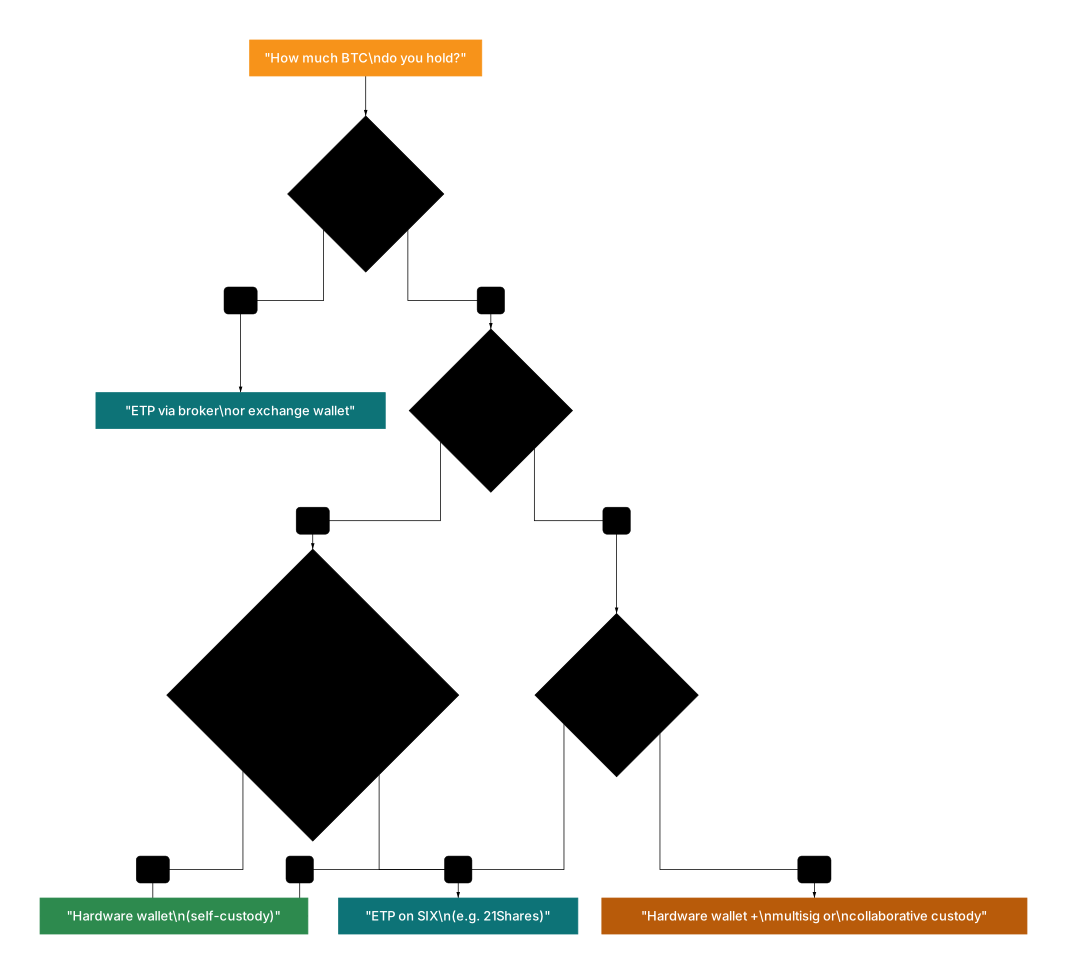
Six variables determine the answer.
How much are you investing? Self-custody — buying a hardware wallet, setting it up, storing the seed phrase securely — is a fixed cost in time and attention. For a position under roughly CHF 5,000, that cost is disproportionate. An ETF is the simpler path. For a position above CHF 50,000, the annual ETP fee over a ten-year holding horizon becomes real money. One percent per year on CHF 50,000 is CHF 500 annually, compounded on a rising asset. The economic case for self-custody grows with position size.
What is your time horizon? Under a year: an ETP is the cleaner instrument, easy to enter and exit, and the fee is immaterial. Over five years — treating bitcoin as long-term savings rather than a near-term trade — self-custody makes more sense. The fee drag matters more. The sovereignty matters more.
Are you comfortable with technical responsibility? Be honest. There is no shame in answering no. Self-custody requires attention to detail: backing up your seed phrase correctly, storing it somewhere that survives a house fire and remains accessible to your family, and not making careless errors when transacting. A bitcoin ETP at a regulated Swiss custodian is far less risky than a self-custody setup done carelessly — seed phrase photographed on a phone, stored in iCloud, never tested.
Do you want to actually use Bitcoin? If your goal is purely investment exposure, either path works. But if you want to use Lightning for payments, send bitcoin internationally, or do anything beyond holding — self-custody is not optional. An ETP gives you price exposure and nothing else. You cannot move, spend, or use ETF shares as money.
Does it need to sit inside an existing investment account? If you invest through a pension vehicle, a discretionary mandate, or a structured savings plan, self-custody is not an option within that structure. An ETP is the only available mechanism. That is not a compromise — it is the correct tool for the context.
Are you buying for someone who is not technically confident? For a parent, partner, or sibling who wants exposure but will not manage a hardware wallet, an ETP is the more responsible recommendation. The downside of losing self-custody access is severe. The downside of a well-run ETP is annual fees.
On "Not Your Keys, Not Your Coins"
The phrase is a fixture of Bitcoin culture. It is worth understanding what it actually means, rather than using it as a rhetorical cudgel.
The claim behind it is straightforward: if you do not hold the private keys to your bitcoin, you do not have unconditional ownership of it. You have a claim against the entity that holds the keys on your behalf. That claim may be legally robust and practically reliable — but it is a claim, not possession. This is the same distinction that exists between holding physical gold and holding a gold ETF. The gold ETF is not a fraud, and neither is a bitcoin ETP. But they are different things.
In the context of a well-regulated European bitcoin ETP, the counterparty risk is real but low. Products listed on the SIX Swiss Exchange are regulated under Swiss law. Bitcoin held by the custodian is typically segregated from the fund manager's operating assets — meaning if 21Shares encountered financial difficulty, the bitcoin held for ETP holders would not be part of the insolvency estate. That is meaningfully different from holding bitcoin on a trading exchange like Binance or FTX, where your funds sit in a pooled account and your claim in an insolvency is weaker.
The honest version of "not your keys, not your coins" is this: you are choosing how much trust to place in institutions. Self-custody places zero trust in institutions and full trust in yourself. An ETP places a defined level of trust in a regulated fund and custodian. Neither is irrational. Which is more appropriate depends on the size of your holding and how carefully you can manage the responsibility of self-custody.
The Hybrid Approach
A large number of thoughtful, experienced bitcoin holders use both paths simultaneously. This is not a compromise or a hedge. It is a deliberate strategy that matches different tools to different purposes.
The typical arrangement is something like this: an ETP for the portion of bitcoin that lives within an investment portfolio — accessible through a brokerage account, tracked on broker statements, usable by a financial advisor, and appropriate for a pension or long-term investment vehicle. And self-custody for the portion treated as long-term savings — held directly, without annual fees, outside the financial system, with full sovereignty.
The ETP portion benefits from familiarity, ease, and regulatory structure. The self-custody portion benefits from zero counterparty risk, zero ongoing fees, and the optionality to actually use Bitcoin if needed. Neither portion is doing the other's job.
Consider a concrete example: CHF 30,000 in bitcoin over a ten-year horizon. CHF 10,000 through a Swissquote account in a 21Shares bitcoin ETP — sitting alongside your other investments, easy to track, no new account needed. CHF 20,000 on a hardware wallet in self-custody — set up carefully, seed phrase stored somewhere your family knows about, no annual fees, no counterparty. After ten years, the ETP has cost roughly CHF 1,400 in fees (at 0.95 percent annually on a growing position). The self-custody portion cost CHF 150 for the hardware wallet, and nothing more. Both tracked bitcoin's price. Both served their purpose.
This split is not required. Some people prefer simplicity and hold everything via ETP. Some prefer sovereignty and hold everything in self-custody. Both are valid. The hybrid exists for those whose situation calls for it.
Five Questions to Find Your Answer
Work through these honestly.
One. Do you already have a brokerage account you trust and use regularly?
Two. Are you willing to spend a few hours learning how to set up and secure a hardware wallet properly — including backing up your seed phrase onto metal or fireproof paper and storing it somewhere safe?
Three. Do you plan to hold bitcoin for five or more years?
Four. Is the amount you are considering more than CHF 10,000?
Five. Do you want to actually spend or use bitcoin — for payments, Lightning transactions, or anything beyond holding?
If you answered yes to three or more of questions two through five, self-custody is worth learning. The investment in time and attention is proportionate to what you are protecting, and the long-term benefits — in fee savings, sovereignty, and optionality — are real. You do not need to do everything at once. Start with a hardware wallet and a small amount while you learn.
If you answered no to most of questions two through five, an ETP is the right starting point. It is not a compromise. It is the appropriate tool for your situation. You can revisit the self-custody question as your holding grows, your time horizon extends, and your comfort with the technology increases.
What to Do Next
If you have decided that an ETP fits your situation, Chapter 6 covers how to find and buy one through a Swiss broker — which products to look for, how to check they are physically backed, and how to compare fees.
If you have decided that self-custody is worth learning, the wallet chapter is your next read. It walks through hardware wallets, setup, and what seed phrase security actually requires.
If you are not yet certain, that is fine. You now understand the trade-offs well enough to return when you are ready. The goal here was not to decide for you — it was to make sure the decision is based on your actual circumstances, not on ideology or someone else's view of what Bitcoin holders are supposed to do.
Chapter Summary
-
A bitcoin ETF or ETP gives you price exposure through a regulated fund. You pay an annual fee. You cannot withdraw actual bitcoin or use it for payments. Counterparty risk is real but manageable with reputable providers on regulated exchanges like SIX.
-
Self-custody gives you actual bitcoin in a wallet you control. No annual fees, no counterparty, no intermediary. Full responsibility for securing your seed phrase and keeping your access intact.
-
The right choice depends on six factors: the size of your holding, your time horizon, your comfort with technical responsibility, whether you want to use Bitcoin, whether it needs to sit inside an existing investment structure, and whether the holder is technically capable of managing self-custody safely.
-
"Not your keys, not your coins" is a real principle, not propaganda. But regulated European ETPs are meaningfully safer than exchange custodians. The risk exists on a spectrum.
-
Many experienced holders use both: an ETP for their investment portfolio allocation, and self-custody for long-term savings held outside the financial system. This is a legitimate, deliberate strategy — not indecision.
-
If you are ready to self-custody, the wallet chapter is your next read. If an ETP fits your situation better, Chapter 6 has the practical steps.
Was this helpful? Continue with the next chapter via the sidebar.
This content is educational and does not constitute financial advice.