Bitcoin's Fast Lane: The Lightning Network Explained
You want to pay for a coffee with Bitcoin. You open your wallet, generate an invoice, and the merchant scans it. The payment leaves your wallet. And then you wait. Ten minutes. Maybe twenty if the network is busy. By the time the transaction confirms, the coffee is cold and the queue behind you has quietly moved to another till.
Even if you're willing to wait, the maths don't work. Sending a few Swiss francs on-chain — directly on the Bitcoin blockchain — costs whatever miners are currently charging to include your transaction in a block. In periods of network congestion, that fee can easily reach CHF 2 to 5 for a single transaction. Paying CHF 5 for a coffee with a CHF 3 fee attached is not a payment system. It is a demonstration that the base layer was never designed for retail payments.
Bitcoin's base layer is built for something else entirely: secure, final, irreversible settlement. It is closer in design to an international wire transfer than to a tap-and-go payment. That is not a flaw. It is the correct trade-off for what the base layer does — anchoring billions of dollars of value, permanently, with no single point of failure.
But the world also needs small, fast, cheap payments. This is exactly the problem the Lightning Network bitcoin layer was built to solve. Lightning is a payment network built on top of Bitcoin that makes instant transactions possible at a fraction of a centime in fees. The coffee payment that would cost CHF 2 in on-chain fees costs less than one centime on Lightning, and it settles in under a second. The same Bitcoin. No new coin. No separate blockchain.
How Lightning Actually Works
The core building block of Lightning is something called a payment channel. The idea is simpler than it sounds.
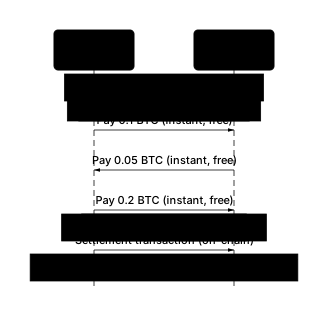
Imagine two people — call them Lena and Marco — who transact frequently. Rather than recording every payment on the Bitcoin blockchain, they open a shared wallet together: a special Bitcoin address that requires both of their signatures to spend from. Each of them deposits some Bitcoin into it. This one opening transaction gets recorded on the blockchain.
Now they can transact freely. Every time Lena pays Marco for something, they update a private record of who owns what inside that shared wallet. These updates never touch the blockchain. They are instant. They cost nothing. They can happen hundreds of times an hour.
When they are done — when Lena closes her tab at the bar — they settle. One final transaction records the end balances on the Bitcoin blockchain. Two blockchain entries for hundreds of transactions. That is where Lightning's efficiency comes from.
The security mechanism is elegant. If either party tries to cheat by publishing an outdated balance — one where they had more money than they actually do — the other party can claim the cheater's entire stake as a penalty. The system is mathematically designed so that attempting to steal costs you everything. There is no need to trust your channel partner. The cryptography enforces honesty.
This works well for two people who transact regularly. But you do not have a payment channel with every coffee shop in Zurich. Lightning solves this through routing.
If Lena wants to pay a café she has never interacted with before, her wallet automatically finds a path through the network. The payment hops from Lena to an intermediate node, then to another, then to the café — each hop secured by a cryptographic lock called a Hash Time-Lock Contract, or HTLC. The mechanics are involved, but the principle is simple: each node in the path can only claim their forwarding fee by passing the payment onward correctly. No node can steal the payment in transit. The whole chain of locks either completes or unwinds entirely — the sender either pays or does not, with no funds lost in the middle.
From the user's perspective, none of this is visible. You scan a QR code. The payment routes itself. The recipient gets their money. The entire process takes one to two seconds.
The Network in Numbers
The Lightning Network is not a concept under development. It is a live network handling real payments around the world.
As of March 2026, the public network has 5,695 active nodes and 17,576 payment channels, carrying roughly 2,710 BTC in total capacity — approximately CHF 150 million. Both the number of nodes and the number of channels have been growing: up 6.87 percent and 12.25 percent respectively in the past thirty days. These are public network statistics only; a significant additional portion of the network operates through private channels that do not appear in public data, so the actual scale is larger.
The network's median routing fee is a fraction of a satoshi — a unit so small it has no meaningful equivalent in Swiss francs. For everyday payments, Lightning fees are so close to zero that they are effectively invisible.
A relatively small number of large, well-connected nodes — including several major exchanges — handle a disproportionate share of routing. This hub-and-spoke concentration is common in network infrastructure generally, and it does not make the network fragile. Payments route around offline nodes automatically. But the concentration is real, and users who care about privacy should know it.
What You Can Do With Lightning Right Now
Lightning delivers what Bitcoin's base layer cannot: everyday spending.
If you are buying something small — a coffee, a meal, a piece of software, a tip to a content creator — Lightning handles it instantly with fees so low they are irrelevant. Merchants who accept Lightning typically integrate it through a Bitcoin payment processor or a Lightning-compatible point-of-sale system. You scan a QR code with your wallet. Done.
Cross-border payments are where the difference becomes obvious. A Swiss resident sending money to family abroad through a traditional bank transfer pays fees of five to ten percent, waits one to five business days, and navigates a system that excludes anyone without a bank account. A Lightning payment takes two seconds and costs fractions of a centime. The recipient needs a Lightning wallet, which is an increasingly low bar as adoption grows in many regions, but the economic difference is substantial. This is the remittance use case that has generated the most real-world adoption in lower-income countries: Lightning as a payment rail that competes directly with services charging ten times more.
Lightning also integrates with Nostr, a decentralized social protocol. Nostr users can "Zap" creators — sending them small amounts of Bitcoin directly, with a single tap, as a form of appreciation or support. No Patreon. No YouTube revenue share. No minimum threshold. A creator posts something you found valuable, you send them twenty satoshis, the payment arrives instantly. This is what native monetization looks like when the payment layer has no friction.
Underpinning much of this is a user experience improvement called a Lightning Address. Your Lightning Address looks exactly like an email address: you might see it written as moh@bicatalyst.ch or satoshi@walletofsatoshi.com. When someone sends to that address, their wallet automatically fetches the right payment details from the provider and completes the payment. No invoice strings to copy. No QR codes to generate in advance. If you can send an email, you can send Bitcoin over Lightning.
Which Wallet to Use in Switzerland
Choosing a Lightning wallet involves one important decision first: do you want to hold your own keys, or would you prefer someone else to manage them for you?
Custodial wallets — where the provider controls the underlying keys — are simpler to use but introduce the same counterparty risk you are trying to avoid with Bitcoin in the first place. Your balance exists as a number in the provider's database. They can freeze it, the company can fail, regulations can restrict access. Custodial Lightning wallets are fine for very small amounts and for getting started. They are not appropriate for holding meaningful savings.
Self-custodial wallets keep you in control. The trade-off is that they require slightly more setup — and historically, managing Lightning channels was technically demanding. Modern wallets have eliminated most of that complexity.
Phoenix is the best non-custodial option for most Swiss users. Developed by the ACINQ team, Phoenix manages your channels automatically through a mechanism called splicing — your wallet essentially has one dynamic channel that adjusts as needed, rather than multiple channels you have to balance manually. The fee model changed significantly in 2023: instead of a one-percent receiving fee, Phoenix now charges only the underlying Bitcoin mining fee when it needs to adjust your channel capacity. The overall cost is much lower and more predictable. Phoenix is available on iOS and Android in Switzerland with no geographic restrictions.
Muun is the most beginner-friendly self-custody option. It presents a single unified balance — no separate on-chain and Lightning balances, just one number. Under the hood, Muun handles Lightning payments through submarine swaps, which means fees can be slightly higher than native Lightning wallets for some transaction types. But for users who want Lightning functionality without any channel management complexity, Muun is a reliable choice. Available in Switzerland on iOS and Android. (Note: Muun uses submarine swaps to bridge between on-chain and Lightning. This means Lightning payments go through Muun's infrastructure, introducing trust assumptions that differ from a native Lightning wallet like Phoenix.)
Wallet of Satoshi offers the simplest possible onboarding. Download, open, receive your Lightning Address, and you are ready to receive and send Bitcoin in under a minute. Wallet of Satoshi is a custodial Lightning wallet — the simplest option for beginners, though it means trusting a third party with your funds. A good option if you want to understand what Lightning feels like before committing to a more advanced wallet.
Zeus is for users who are already running their own Lightning node — or who want to. It connects to your own node infrastructure and gives you full control over channels, fees, and routing. Not a beginner option, but the right choice for technically advanced users who want full sovereignty over their Lightning setup.
Strike is not available in Switzerland. It is a well-known app in the US market, primarily used for dollar-denominated remittances, but it does not support Swiss accounts. Do not attempt to use it from Switzerland. Breez, another well-regarded wallet, has also been transitioning its model toward providing infrastructure for developers rather than a standalone consumer app — verify its current app store status before using it.
What Lightning Cannot Do
Lightning has real limitations every user should know.
Routing does not always succeed. For small payments — the kind you would make buying a coffee or tipping a creator — routing failures are rare with modern wallets. For larger payments, particularly those exceeding a few thousand CHF worth of Bitcoin, routing becomes less reliable because fewer channels can carry that amount. Lightning is a payments layer built for smaller transactions. If you need to move a substantial amount of Bitcoin, the base layer — with its higher fees and slower confirmation — remains the more appropriate choice.
Liquidity is the hidden variable. To send a payment, your channel needs enough outbound capacity. To receive one, there needs to be enough inbound capacity pointed toward you. Non-custodial wallets like Phoenix manage this automatically, but "automatically" means "at a cost": when you receive more than your current channel can handle, the wallet opens more capacity and charges you the on-chain fee for doing so. This is usually small and predictable, but it is not zero.
Privacy on Lightning is better than on-chain in some respects — payments are not permanently recorded on a public blockchain — and worse in others. The channel graph is public. Your channel partners know your balance. Sophisticated analysis of the network graph can sometimes draw inferences about payment flows. If you are paying for something genuinely sensitive, Lightning's privacy model deserves a careful look before you assume it provides complete anonymity.
The public network also reflects the concentration of routing through large, well-known nodes. About half of all public Lightning nodes use Tor to add network-level privacy, but the routing infrastructure itself is visible. For most everyday payments — coffee, cross-border transfers, content tips — this is not a meaningful concern. For users with specific privacy requirements, it matters.
Lightning and Swiss Tax
Swiss tax treatment of Bitcoin does not change when it moves over Lightning. Bitcoin is Bitcoin, whether the transaction settles on-chain or through a Lightning channel.
For private investors in Switzerland, capital gains on Bitcoin are tax-free. This applies whether you received or spent that Bitcoin over Lightning or through a standard on-chain transaction. The Federal Tax Administration does not treat the two differently for individuals holding Bitcoin as private assets.
Bitcoin received as payment for goods or services — regardless of whether it arrives over Lightning — is taxable income at the fair market value at the time of receipt. This is true on-chain, and it is equally true on Lightning.
One area without official guidance from the ESTV as of this writing: routing node operators who earn fees for forwarding payments. If you run an active routing node and earn meaningful routing fees, that income is in a grey area — potentially treated as business income depending on volume and intent. If you are operating a routing node professionally, consult a Swiss tax adviser before assuming it is tax-free.
For the vast majority of Swiss readers — holding Bitcoin as a personal savings asset and making occasional Lightning payments — there is nothing complicated here. Your existing tax treatment applies. Lightning adds no new tax dimension.
To find Lightning-accepting merchants near you in Switzerland, btcmap.org maintains a live, community-updated map of physical businesses that accept Bitcoin and Lightning across the country. The count changes regularly — check there rather than any static number this chapter could provide.
Your First Lightning Payment
The most useful thing you can do after reading this chapter is make a real Lightning payment. The concepts are easier to understand once you have felt how different it is from an on-chain transaction.
Download Phoenix or Muun. Fund your wallet with a small amount — CHF 20 to 50 is more than enough. Then find a Lightning-enabled merchant near you through btcmap.org and make a payment, or send yourself a small amount to a Lightning Address to see how the experience feels. If you do not want to spend money at a merchant yet, any wallet with a Lightning Address can receive a test payment from your own second wallet in under a second.
The friction you will notice is on setup, not on the payment itself. Once your wallet has its channel capacity, sending a Lightning payment feels more like a contactless card tap than like moving money. That contrast — between what on-chain Bitcoin requires and what Lightning delivers — is the whole point.
Chapter Summary
-
Bitcoin's base layer is designed for secure, final settlement, not everyday payments. On-chain transactions cost CHF 2 to 5 in fees during normal network conditions and take ten or more minutes to confirm.
-
The Lightning Network is a payment layer built on top of Bitcoin. It works through payment channels — shared Bitcoin wallets where two parties transact freely and settle to the blockchain only when they are done. No new coin is created.
-
Payments route automatically across the network through connected nodes. Cryptographic locks at each hop ensure no node can steal funds in transit. From a user perspective, payments take one to two seconds and cost fractions of a centime.
-
For Swiss users, Phoenix offers the best non-custodial experience with automatic channel management. Muun is the simplest beginner option. Wallet of Satoshi works for very small amounts or first-time users. Strike is not available in Switzerland.
-
Lightning is not the right tool for large transactions — those are better handled on-chain. Routing can fail for large amounts, and liquidity management adds some complexity for self-custodial wallets.
-
Swiss tax treatment is unchanged: capital gains on Bitcoin held as private assets remain tax-free, whether transacted on Lightning or on-chain. Routing fees from running a node are a grey area — take professional advice if relevant.
Was this helpful? Continue with the next chapter via the sidebar.
This content is educational and does not constitute financial advice.